

 By Mr.Sun
A tensile report describes the specimen that was tested. Understanding how that specimen relates to a delivered casting is essential when interpreting the result. A separately cast bar, an attached coupon and a sample removed from the component do not automatically have identical thermal histories or represent the same location.
The correct sampling route is the one required by the applicable specification and purchase agreement. Buyers should establish it before production, particularly when a component has large section changes or when destructive testing would consume an expensive finished part.
Ask what the specimen represents
A separately cast test bar can provide a practical and traceable means of verifying a heat under the prescribed conditions. Its value depends on compliance with the material specification, including how it is cast and treated. It should not be described as a direct measurement of every local property throughout a complex component.
A specimen taken from the casting addresses a particular location more directly, but it consumes material and still represents that selected position and orientation. One extracted specimen cannot establish every property at every section. The inspection plan should state both the purpose and the limits of the evidence.
Compare sampling routes before committing tooling
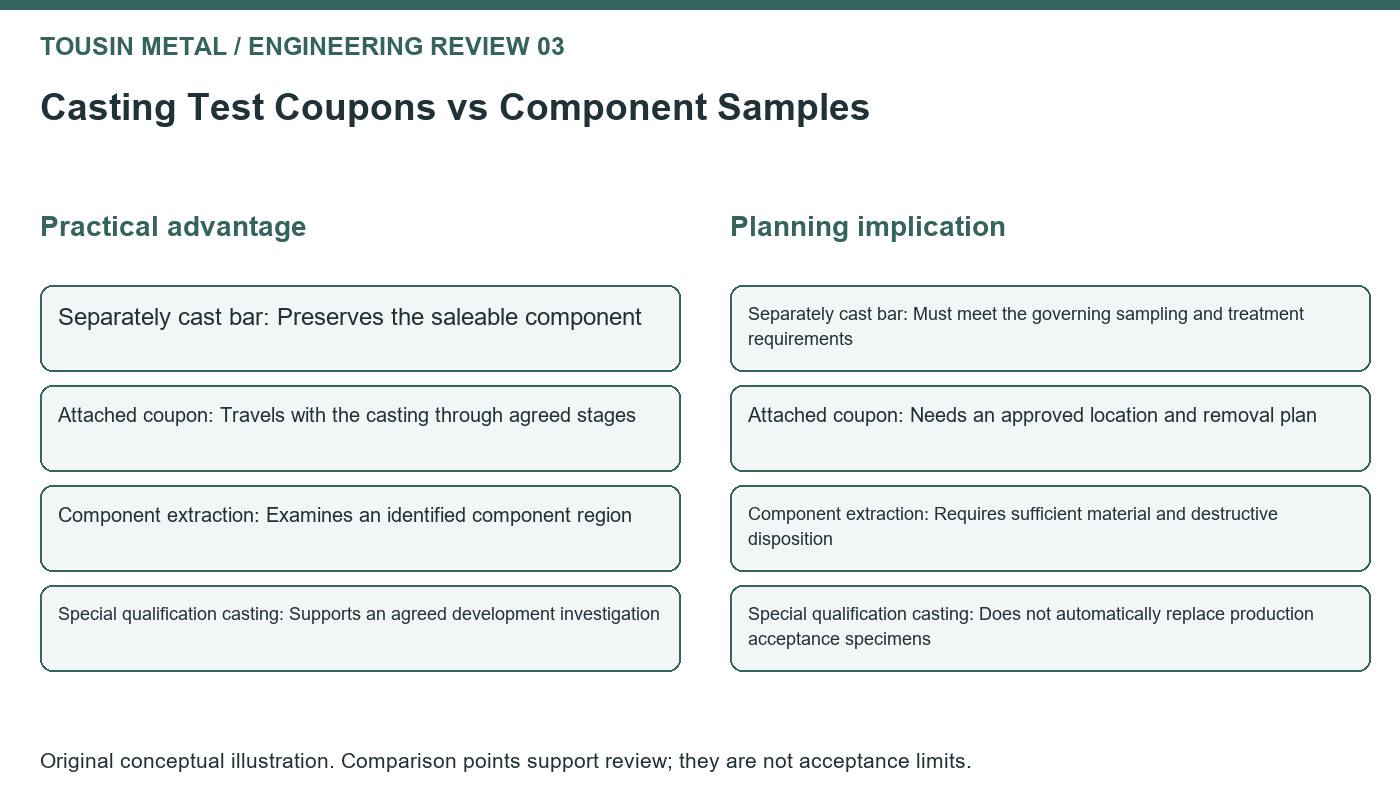
| Sampling route | Practical advantage | Planning implication |
|---|---|---|
| Separately cast bar | Preserves the saleable component | Must meet the governing sampling and treatment requirements |
| Attached coupon | Travels with the casting through agreed stages | Needs an approved location and removal plan |
| Component extraction | Examines an identified component region | Requires sufficient material and destructive disposition |
| Special qualification casting | Supports an agreed development investigation | Does not automatically replace production acceptance specimens |
The comparison is not a ranking. The buyer may need one route for specification acceptance and a different route for a development question. Labeling those purposes clearly prevents an additional engineering study from becoming an unplanned shipment requirement.
Preserve the processing history
Specimen identity must survive the stages that establish the reported properties. If a casting receives a required heat treatment, the sampling rules should explain how the test material is associated with that treatment. A record that identifies only the melt, without the required processing linkage, may leave the evidence incomplete.
The same care applies when parts are split into different treatment loads or processing routes. The manufacturer should follow the specification’s definition of the relevant lot rather than assuming that one original melt always equals one final acceptance lot. This distinction should be settled before the test laboratory receives the samples.
Mark location and orientation on a sketch
For component extraction, an annotated drawing is more useful than the phrase ‘test from casting.’ It can identify the section, extraction direction, depth and specimen type. Machining access and the available material envelope should be reviewed while the component is still being planned.
Suppose a purchaser wants information about a heavily loaded mounting region. Cutting a specimen from a convenient thin tab elsewhere would answer a different question. If the intended location cannot produce a valid specimen, the parties need an agreed alternative and a clear statement of what that alternative demonstrates.
Plan the response to an invalid or failed test
A machining error, incorrect specimen dimensions or a testing problem is different from a valid result that does not meet the requirement. The applicable specification normally governs how such situations are evaluated, including whether retesting is permitted. An informal decision to keep testing additional bars until one passes undermines traceability.
The purchase agreement should identify who reviews the laboratory report and who authorizes disposition. Any additional investigation should preserve the original result and the reason for the follow-up. A clear chronology is more useful than a replacement certificate that hides the initial event.
Include specimen planning in the enquiry
For Tousin Metal projects, provide the material specification, required mechanical tests and any component-specific sampling expectations together. This allows coupon material, machining and inspection lead time to be included in the route. It also avoids discovering after finishing that the only acceptable specimen location is inside a part already promised for assembly.
Reference material
SFSA: Steel Castings Handbook, Supplement 6 provides background on steel casting properties and testing. Use the actual ordered material specification for specimen requirements, lot definitions and retest provisions; the comparison here is a planning guide rather than a substitute acceptance procedure.


