

 By Mr.Sun
Ordering a steel casting for cold service requires more detail than asking for ‘good toughness.’ A Charpy impact result depends on the specimen, test temperature and specified acceptance rule. Without those details, a supplier and buyer can produce valid-looking reports that address different requirements.
Impact testing is one part of material qualification. It does not independently establish a component’s allowable load, fracture resistance in every geometry or suitability for an entire operating system. The design authority must connect the material requirement to the actual service and governing rules.
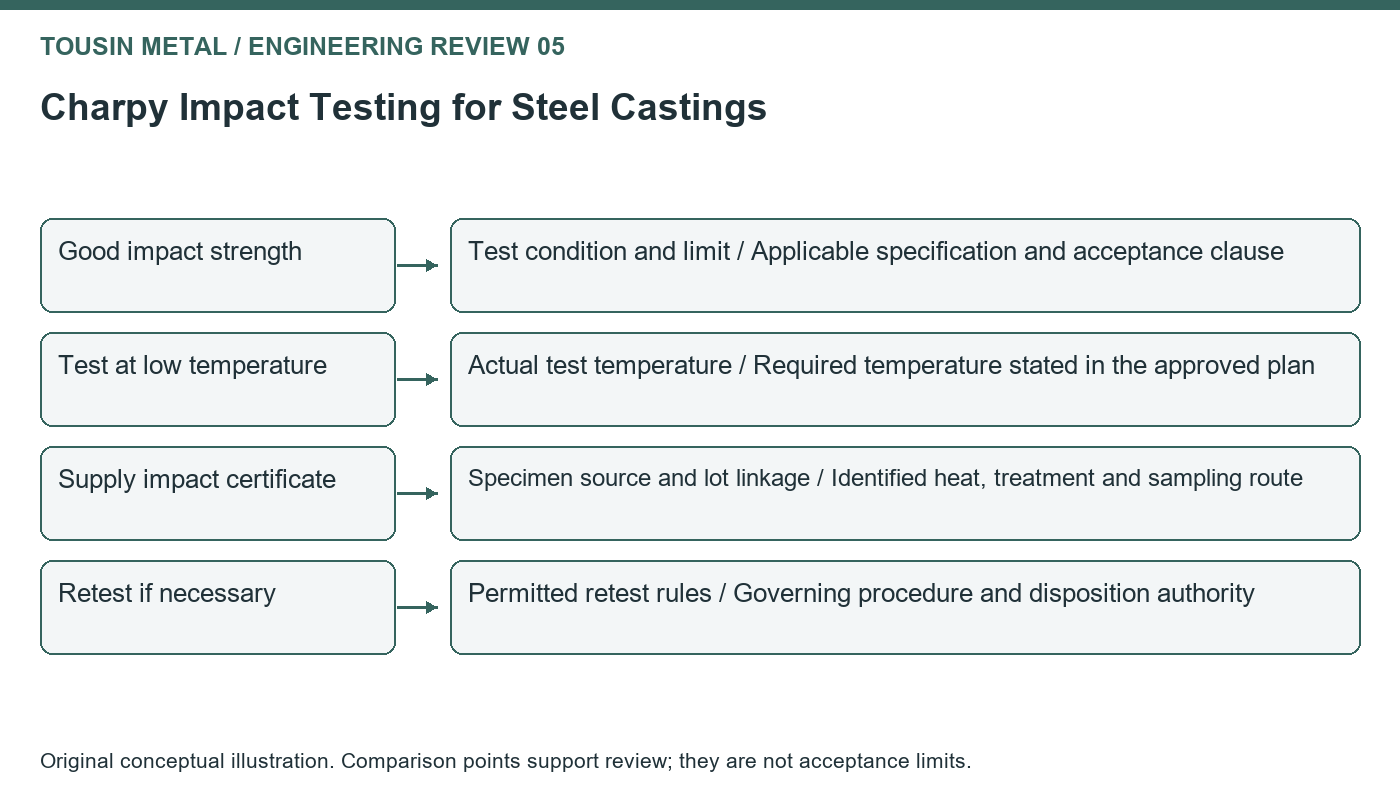
Begin with the minimum service condition
The design review should identify the relevant temperature envelope, including conditions that may occur during startup, shutdown or an upset. The resulting test requirement must come from the applicable design and material specifications. Selecting a test temperature solely because the laboratory routinely uses it can leave a gap between the order and the intended service.
A component’s nominal operating temperature may not describe every relevant case. That is why the foundry needs the approved material requirement rather than an informal description such as outdoor use or winter operation. The engineering decision belongs in the controlled purchase documentation.
Specify the specimen and acceptance basis together
The test plan needs the specimen type and size, required temperature, number of specimens and acceptance criteria. If the specification permits subsize specimens or other alternatives, follow its provisions explicitly. Results obtained under different specimen conditions should not be compared as though they were interchangeable.
| Order wording | What remains unclear | Better-defined requirement |
|---|---|---|
| Good impact strength | Test condition and limit | Applicable specification and acceptance clause |
| Test at low temperature | Actual test temperature | Required temperature stated in the approved plan |
| Supply impact certificate | Specimen source and lot linkage | Identified heat, treatment and sampling route |
| Retest if necessary | Permitted retest rules | Governing procedure and disposition authority |
This level of definition avoids turning the final certificate review into a negotiation about what the test was supposed to mean.
Connect the specimen to the delivered condition
The sampling route and processing history matter. A result from a specimen in one heat-treatment condition does not automatically qualify castings delivered in another. The records should identify the relevant heat and treatment lot as required by the material specification.
If a component receives additional processing after the initial test material was prepared, the responsible engineer should determine whether the original evidence remains applicable. The shop should not make that decision by assuming that a later thermal operation has no effect. Record the agreed route before production rather than reconstructing it after a discrepancy.
Do not translate absorbed energy into a universal design limit
A Charpy test is a standardized impact test on a notched specimen. Its result should not be presented as a direct allowable stress for a finished casting or as a universal fracture-toughness value. Different tests answer different engineering questions.
For example, an acceptable impact report does not remove the need to evaluate a sharp geometric transition or an impermissible discontinuity in a loaded component. Material acceptance, design assessment and casting inspection work together. None should be described as a complete substitute for the others.
Agree how nonconforming results will be handled
The order should reference the applicable retest and disposition provisions. Preserve individual results as well as any required averages. A summary showing only a favorable average may be incomplete when the specification also controls individual values.
When requesting cold-service castings from Tousin Metal, include the material specification, required delivery condition and impact-testing details with the drawing. This allows the test material and laboratory schedule to be planned before the casting reaches final inspection. It also prevents an otherwise complete shipment from waiting on a test that was never defined.
Sources for specification planning
SFSA: Standards and Specifications for Steel Castings and SFSA: Steel Castings Handbook, Supplement 6 provide relevant background. The ordered specification controls the actual specimen, temperature, acceptance and retest requirements; no numerical limit in this article is offered as a universal rule.


