

 By Mr.Sun
The corrosion behavior of a stainless casting depends partly on what it touches. A bracket or fitting may be suitable as an individual component yet create a different situation when joined to aluminum, carbon steel or another metal in a wet environment. Evaluating the casting alone can therefore miss an assembly-level risk.
Galvanic interaction requires the relevant electrochemical conditions, including an electrical connection and an electrolyte. The engineering review should examine the complete current path and exposure instead of using a material name as a universal pass-or-fail rule.
Draw the electrical path through the joint
A plastic washer beneath a bolt head may look like isolation, but another contact path can remain through the bolt shank, sleeve, mating face or neighboring component. Trace the entire joint rather than inspecting only the most visible interface.
The review should also consider how the assembly changes in service. Movement, compression, wear or damaged coatings can create contact that was absent during an initial inspection. An isolation concept should remain functional under the mechanical conditions of the joint, not merely when the parts are loosely placed together.
Include wet area and drainage in the assessment
Worldstainless’s guidance on contact with other metallic materials explains why environmental conditions and area relationships matter. A simple ranking of metals is not a complete design assessment. The wetted surfaces, exposure and local geometry influence the practical outcome.
Water trapped under a mounting plate can create a different condition from a freely draining exposed surface. Before specifying a higher-alloy casting, examine whether the assembly contains avoidable water traps or damaged protective surfaces. Material selection and joint detailing should be reviewed together.
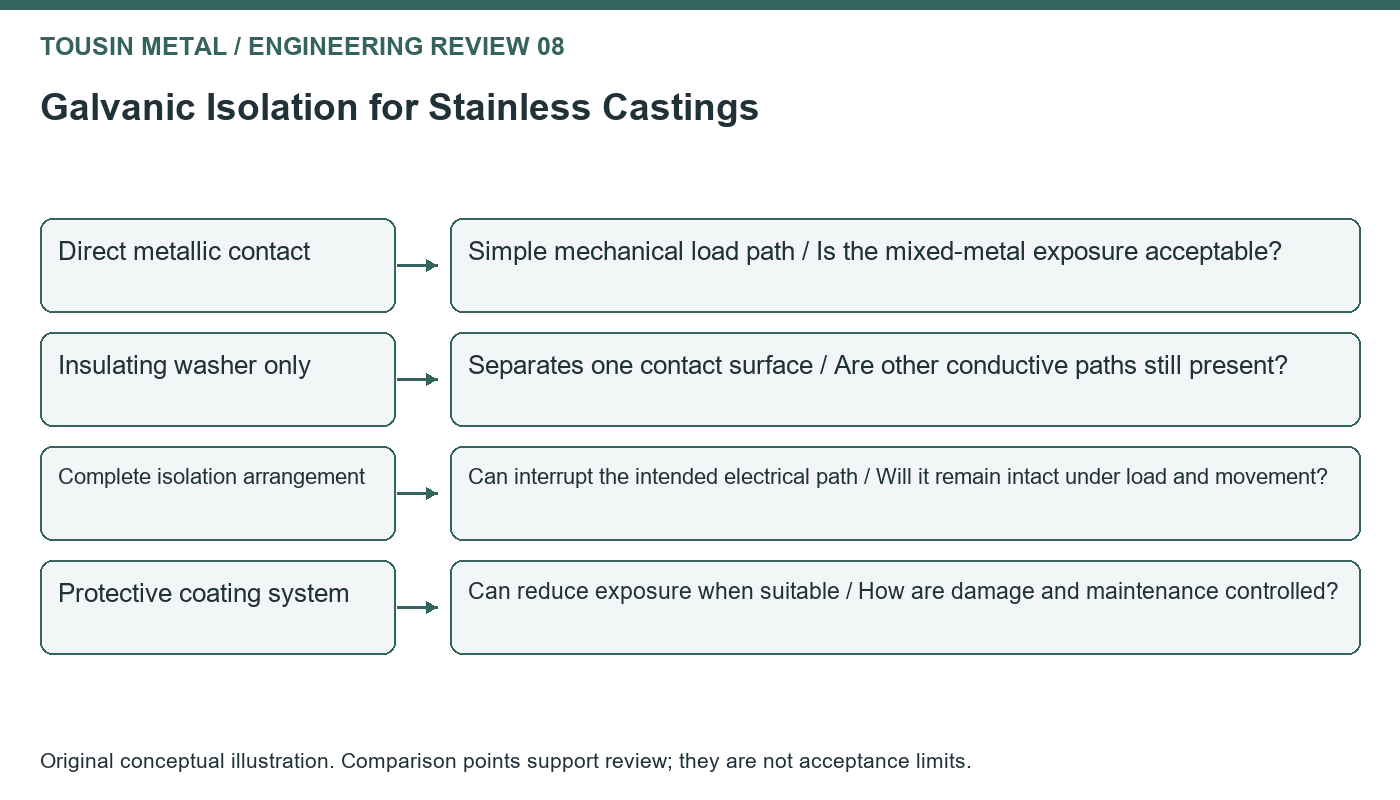
| Joint approach | Design opportunity | Remaining question |
|---|---|---|
| Direct metallic contact | Simple mechanical load path | Is the mixed-metal exposure acceptable? |
| Insulating washer only | Separates one contact surface | Are other conductive paths still present? |
| Complete isolation arrangement | Can interrupt the intended electrical path | Will it remain intact under load and movement? |
| Protective coating system | Can reduce exposure when suitable | How are damage and maintenance controlled? |
Keep isolation compatible with mechanical function
An insulating component also becomes part of the mechanical stack. Its compressibility, temperature behavior and durability can affect preload and alignment. Do not add a soft layer to a loaded joint without reviewing its consequences for the assembly.
The drawing should define the complete stack where isolation is required: sleeves, washers, contact faces and any relevant clearances. Procurement should control the actual materials rather than accepting an unspecified plastic substitute. The corrosion objective is not achieved if the mechanical joint loses its intended function.
Inspect the assembled condition
A practical verification plan examines the joint after installation, including whether the isolating pieces are present and correctly located. Where electrical isolation is a requirement, use an agreed verification method appropriate to the assembly. Visual inspection alone may not establish the required result.
An illustrative case is a stainless fitting mounted to an aluminum panel with an insulating pad but uninsulated fasteners. The pad separates the large mating faces while the fasteners maintain an electrical connection. The review must decide whether that arrangement meets the design intent rather than assuming the pad alone solves the problem.
Provide the supplier with interface information
When ordering from Tousin Metal, identify mating materials and any surfaces that require isolation or protective treatment. The casting supplier needs the controlled interface dimensions, while the assembly designer remains responsible for the complete joint and its service conditions.
This information is especially useful before machining because sleeves, pads or sealing features may require controlled geometry. Adding them after the casting is finished can introduce an unintended tolerance stack or interfere with the designed contact area.
Reference for joint design
Worldstainless: Stainless Steel in Contact with Other Metallic Materials provides background on galvanic interactions. The joint examples above illustrate review questions; the correct isolation arrangement depends on the application’s mechanical and environmental requirements.


