

 By Mr.Sun
A crack-like indication on a steel casting needs a controlled disposition, but its origin is a separate investigation. Damage associated with the final stages of solidification differs from cracking that develops during later cooling, treatment, handling or service. Treating every crack as a hot tear can send corrective action toward the wrong stage.
The first priority is to identify and contain the affected material under the quality procedure. Then preserve enough evidence to establish when and how the condition developed. Cleanup or repair performed too early can remove the most useful information.
Establish the manufacturing timeline
Record the inspections and processing stages that the part has already passed through. If an earlier documented examination covered the same region, it may help narrow the investigation. Absence of a record is not proof that the indication was absent.
The timeline should identify heat treatment, straightening, machining and any other relevant operations without assuming one is responsible. The objective is to build an evidence-based sequence rather than assign blame to the last operator who touched the part.
Use geometry as a clue, not a verdict
The position relative to junctions, constrained regions and section changes can be informative. However, location alone does not establish the mechanism. The investigation may require examination of the fracture surface, metallography or other specialist work.
| Investigation question | Early solidification-related concern | Later-stage cracking concern |
|---|---|---|
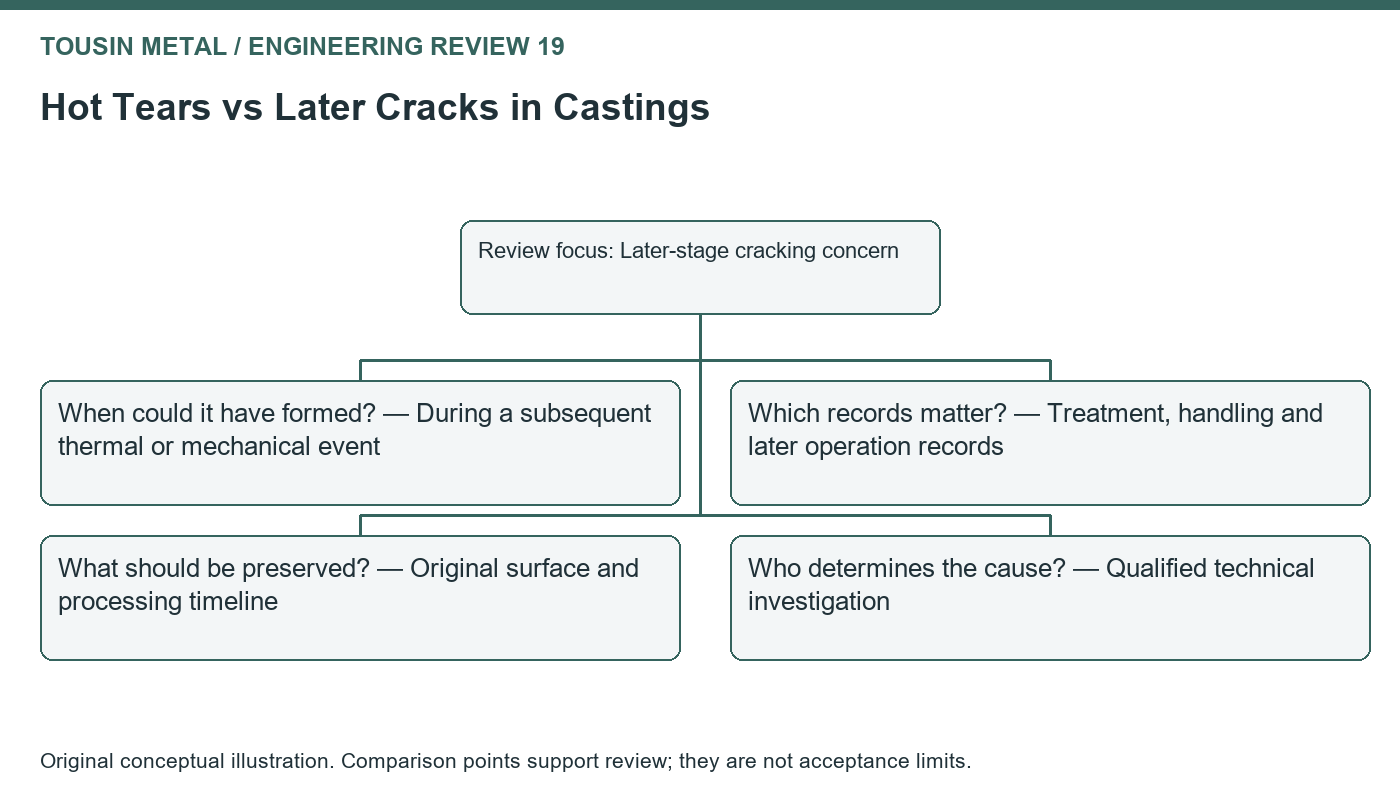
| When could it have formed? | During the casting’s formation | During a subsequent thermal or mechanical event |
| Which records matter? | Casting configuration and process | Treatment, handling and later operation records |
| What should be preserved? | Original surface and local geometry | Original surface and processing timeline |
| Who determines the cause? | Qualified technical investigation | Qualified technical investigation |
The comparison deliberately avoids visual shortcuts that claim every mechanism can be identified from color or shape alone.
Separate examination from acceptance criteria
A nondestructive examination can detect an indication, but the applicable acceptance standard determines how it is evaluated. The report should identify the method, coverage and result without quietly substituting a new acceptance rule.
If additional destructive examination is needed for diagnosis, agree which sample will be used and preserve its identity. Do not remove a section from a customer’s saleable component without the appropriate disposition. The investigation plan should state how the remaining material will be handled.
Do not repair away the investigation
Grinding or welding can eliminate access to the original surface. Before rework, determine whether a representative sample must be retained. Record the proposed repair separately from the cause analysis so a successful repair is not mistaken for proof of the original mechanism.
Any repair must follow the contract’s permissions and required reinspection. A general ability to weld steel does not authorize repair of every casting or every location. If the drawing prohibits repair, that restriction governs the disposition.
Verify the corrective action at the relevant stage
Once the cause is established, the verification should examine the stage and feature associated with that cause. A final visual check alone may not demonstrate that the underlying process change is effective. The quality record should connect the observed problem, technical conclusion, action and follow-up evidence.
For a Tousin Metal investigation, provide part identity, affected location, photographs and any known processing history. Clear evidence supports a proportionate response and helps prevent an unsupported diagnosis from becoming a permanent production instruction.
Technical background
SFSA Publications includes resources on hot tears and steel casting troubleshooting. ICI’s Casting Defect Index provides terminology. A confirmed mechanism requires appropriate examination of the actual casting.


