

 By Mr.Sun
A corrosion-test certificate can provide useful evidence, but only when its test conditions answer the question being asked. A laboratory coupon and a casting operating inside a real assembly experience different environments. Treating either result as a universal service-life guarantee creates a gap between the test and the engineering decision.
For stainless casting projects, establish whether the objective is material screening, process verification or evaluation of an application. The same test does not necessarily serve all three purposes. The result should be reported with enough context that another engineer can understand what was exposed, how it was prepared and what constituted acceptance.
Match the exposure to the investigation
A controlled laboratory method can make comparisons repeatable. Its solution, temperature, duration and specimen preparation are deliberately defined. Those controls are strengths when evaluating a specified material characteristic, but they are not a complete reproduction of every operating condition.
A service trial includes the actual assembly and operating influences, but it can be harder to interpret. Changes in cleaning, deposits, temperature and operating practice may occur together. If the trial lacks a documented baseline, a satisfactory outcome can be difficult to reproduce and an unsatisfactory one can be difficult to diagnose.
Compare what each route can demonstrate
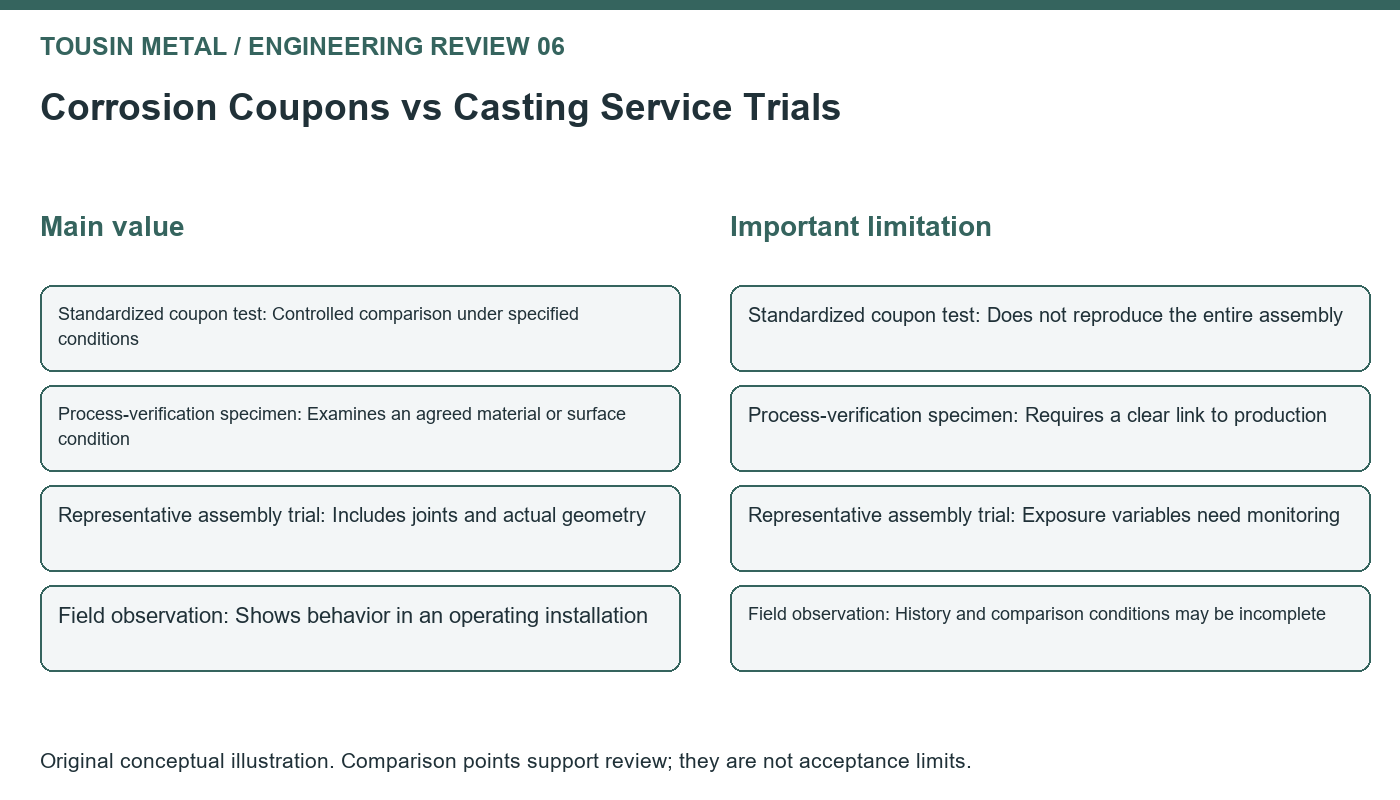
| Evaluation route | Main value | Important limitation |
|---|---|---|
| Standardized coupon test | Controlled comparison under specified conditions | Does not reproduce the entire assembly |
| Process-verification specimen | Examines an agreed material or surface condition | Requires a clear link to production |
| Representative assembly trial | Includes joints and actual geometry | Exposure variables need monitoring |
| Field observation | Shows behavior in an operating installation | History and comparison conditions may be incomplete |
The routes can complement each other. A coupon test might screen a material condition, while an assembly trial examines the effect of a joint detail. The final report should keep those conclusions separate.
Make preparation part of the record
The tested surface is part of the test article. A polished laboratory coupon may not represent a rough internal region, a ground repair or a joint assembled with trapped residues. Record preparation and identify whether the specimen represents the as-cast, machined or finished condition of interest.
If a casting receives a surface treatment before delivery, decide whether the evaluation should include that treatment. A result obtained on a differently prepared specimen can still be informative, but the report must not imply that it directly qualifies every delivered surface. Photographs and a specimen sketch can prevent ambiguity about exposed areas.
Define observations before the trial starts
An inspection plan should state what will be measured or recorded and how the outcome will be judged. Depending on the specified method, the relevant evidence may involve appearance, localized attack, mass change or another defined characteristic. Do not replace the prescribed evaluation with whichever observation looks most favorable afterward.
For an assembly trial, record the operating conditions and interruptions. A component that spends most of the trial dry has not necessarily demonstrated performance in continuous wet service. Similarly, a short development trial should not be presented as a quantified long-term life prediction without a justified engineering basis.
Keep material selection and geometry connected
An illustrative failure investigation might find attack concentrated beneath a gasket while an exposed coupon remains satisfactory. That does not necessarily mean the laboratory result was wrong. The local assembly condition can be different from the coupon environment, so the next investigation should examine the joint as well as the alloy.
When discussing an application with Tousin Metal, provide the intended exposure and any required corrosion-test method. If the method has not been selected, involve the responsible materials specialist before committing to an acceptance claim. A precise test objective is more useful than a request for a general corrosion-resistant certificate.
Background reading
Nickel Institute: Stainless Steel and Nickel-Base Castings provides metallurgical context. Worldstainless: Stainless Steel in Contact with Other Metallic Materials discusses assembly-related interactions. Project tests should follow the specified method and its current contractual edition.


