

 By Mr.Sun
A stainless casting can pass its dimensional inspection and still suffer thread damage during assembly. Galling is associated with adhesive damage between sliding contact surfaces; it is not simply another name for an undersized hole or an incorrect pitch. The assembly process and mating fastener therefore belong in the review.
The practical objective is to create a threaded joint that can be assembled and serviced under its intended conditions. That requires coordination between the casting drawing, machining operation, fastener selection and assembly instructions rather than an isolated instruction to make the surface shinier.
Confirm the failure mechanism first
Cross-threading, burrs, debris, incorrect thread form and galling can all create a complaint that a fastener is difficult to turn. Inspect the damaged surfaces and assembly history before selecting a remedy. Forcing a seized fastener further can obscure the original evidence and damage the casting.
A thread gauge checks specified geometric characteristics; it does not reproduce every loaded assembly condition. Passing the gauge is necessary where required, but it should not be described as proof that galling cannot occur with the actual mating part and installation method.
Review the complete material pairing
The Nickel Institute’s fastener guidance discusses galling and the importance of material and assembly choices. For a cast body with a machined female thread, the review should include both members of the joint and any approved surface treatment. A change to the fastener alone may also affect corrosion behavior or mechanical requirements.
Do not choose an alternative material solely because it appears less likely to seize. The design authority still needs to verify strength, temperature capability and environmental compatibility. A successful anti-galling change must remain suitable for the complete assembly.
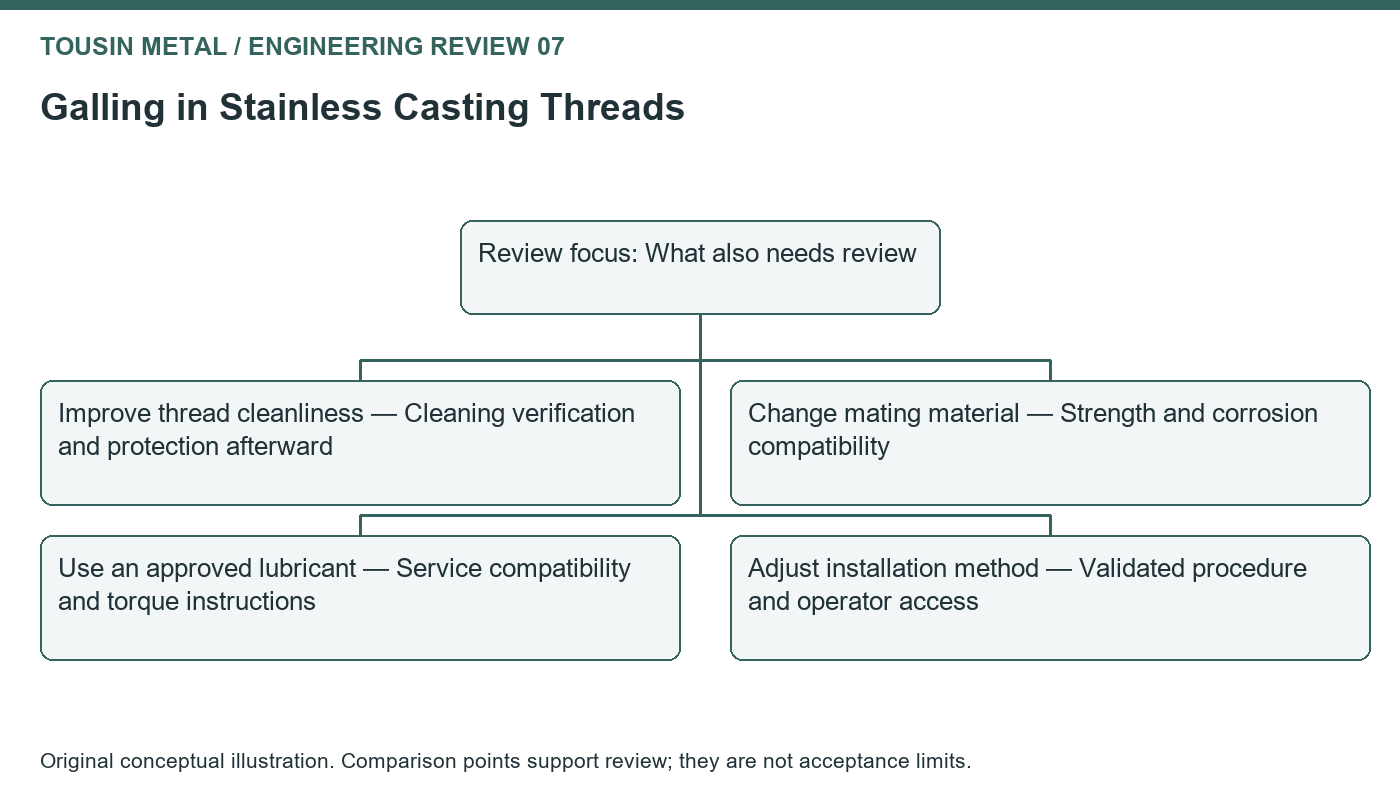
| Proposed action | Potential benefit | What also needs review |
|---|---|---|
| Improve thread cleanliness | Removes avoidable interference | Cleaning verification and protection afterward |
| Change mating material | May alter adhesive contact behavior | Strength and corrosion compatibility |
| Use an approved lubricant | Can change friction during assembly | Service compatibility and torque instructions |
| Adjust installation method | Can improve assembly control | Validated procedure and operator access |
Do not add lubricant without reviewing torque
Lubrication changes the relationship between applied torque and resulting bolt load. An assembly procedure developed for one friction condition should not be carried over automatically after adding a lubricant or anti-seize compound. The responsible engineer must review the installation requirement.
Compatibility also matters. Food-contact, oxygen, high-temperature and other specialized services may restrict permissible products. A generic workshop compound should not be introduced simply because it is readily available. The approved product and application method belong in the assembly documentation.
Protect the thread after machining
Chips, abrasive residue and damaged lead threads can make assembly harder and complicate an investigation. Include deburring and cleaning in the route, then protect the finished feature during handling and transport. The protection method should not leave residues that conflict with the intended service.
An assembly trial can help evaluate a proposed combination, but it should use representative components and a documented procedure. Repeatedly tightening the same test pair until it fails may answer a different question from a single production installation. Define the number of cycles and inspection objective in advance.
Turn the trial into a repeatable instruction
Record the casting grade, fastener specification, thread condition, approved lubricant if any, installation method and observed result. If the trial leads to a change, update the controlled documentation so production does not revert to the old combination.
For threaded components from Tousin Metal, provide the mating fastener information with the casting drawing when assembly behavior is important. The foundry and machinist can then plan the feature and its protection, while the assembly authority establishes the final joint procedure.
Technical source
Nickel Institute: Stainless Steel Fasteners—A Systematic Approach to Their Selection provides background on fastener selection and galling. The article’s trial and documentation examples are planning recommendations, not a universal torque or lubricant specification.


