

 By Mr.Sun
A narrow slot may be easy to model but difficult to carry through wax production, shell building, metal pouring and cleanup. Its feasibility depends on more than the final opening width. Depth, neighboring surfaces and access for the foundry process all influence the result.
The useful design question is whether the complete route can create and verify the feature reliably. A drawing review should examine the slot as a three-dimensional region, not merely compare its width with a general capability number.
Consider the space around the wax feature
Shell building involves applying and drying ceramic layers around the pattern. Closely spaced features can restrict access and make local processing more difficult. The foundry needs to evaluate the actual geometry and its shell system rather than accept a slot solely because another part had a similar opening.
Depth and orientation matter. A shallow open notch and a long enclosed gap can have the same nominal width but present different access conditions. Provide section views where the model does not clearly communicate the restricted region.
Compare casting the opening with machining it
| Route | Potential advantage | Tradeoff to evaluate |
|---|---|---|
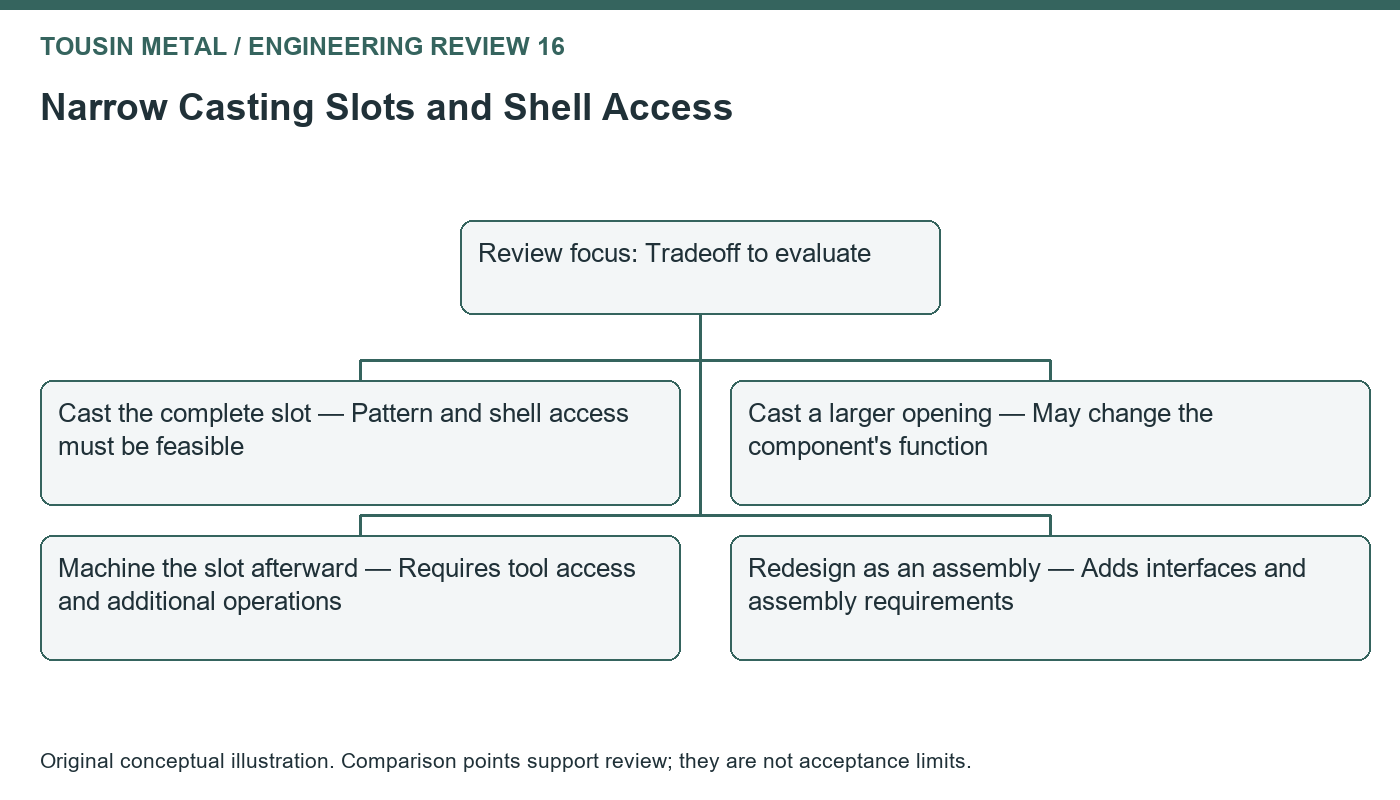
| Cast the complete slot | Reduces material removal | Pattern and shell access must be feasible |
| Cast a larger opening | Improves access | May change the component’s function |
| Machine the slot afterward | Gives a controlled finishing route | Requires tool access and additional operations |
| Redesign as an assembly | Can open inaccessible geometry | Adds interfaces and assembly requirements |
These alternatives should be compared against the function. A larger opening is not an improvement if it changes stiffness, shielding or flow behavior beyond the approved design.
Protect cleanup and inspection access
Even a successfully formed slot needs an agreed final condition. Determine how residual material will be removed and how the region will be examined. A requirement for a clean, uniform surface is incomplete if no tool or inspection method can reach it.
If a borescope or other aid is needed, confirm that it can view the relevant surfaces. Looking into the mouth of a deep slot may leave hidden regions unexamined. The inspection plan should describe coverage honestly rather than calling limited visibility a complete check.
Use samples to answer a defined question
A trial should identify the specific concern: slot completion, surface condition, dimensional consistency or another requirement. Record the manufacturing configuration so the result can be linked to the proposed production route. A successful one-off sample does not establish the performance of an untested process change.
If the feature fails, inspect the evidence before widening it or increasing process intensity. The cause could be related to a particular stage, and a geometry change may not address it. The foundry should lead the process investigation while the designer controls any functional revision.
Keep numerical limits project-specific
Avoid specifying a universal minimum slot width without considering alloy, depth, pattern route and finishing requirements. The foundry’s feasibility review should state the conditions under which the proposed feature can be supplied. Any exceptions should be resolved before tooling release.
For a Tousin Metal enquiry, include a section through the restricted area and mark its function. That gives the manufacturing review a clear basis for comparing cast and machined alternatives without changing the rest of the component unnecessarily.
Process background
Investment Casting Institute: Wax and Casting Defects Resource offers background for foundry investigations. The slot comparisons here are design-review scenarios, not published capability limits for a particular shell system.


